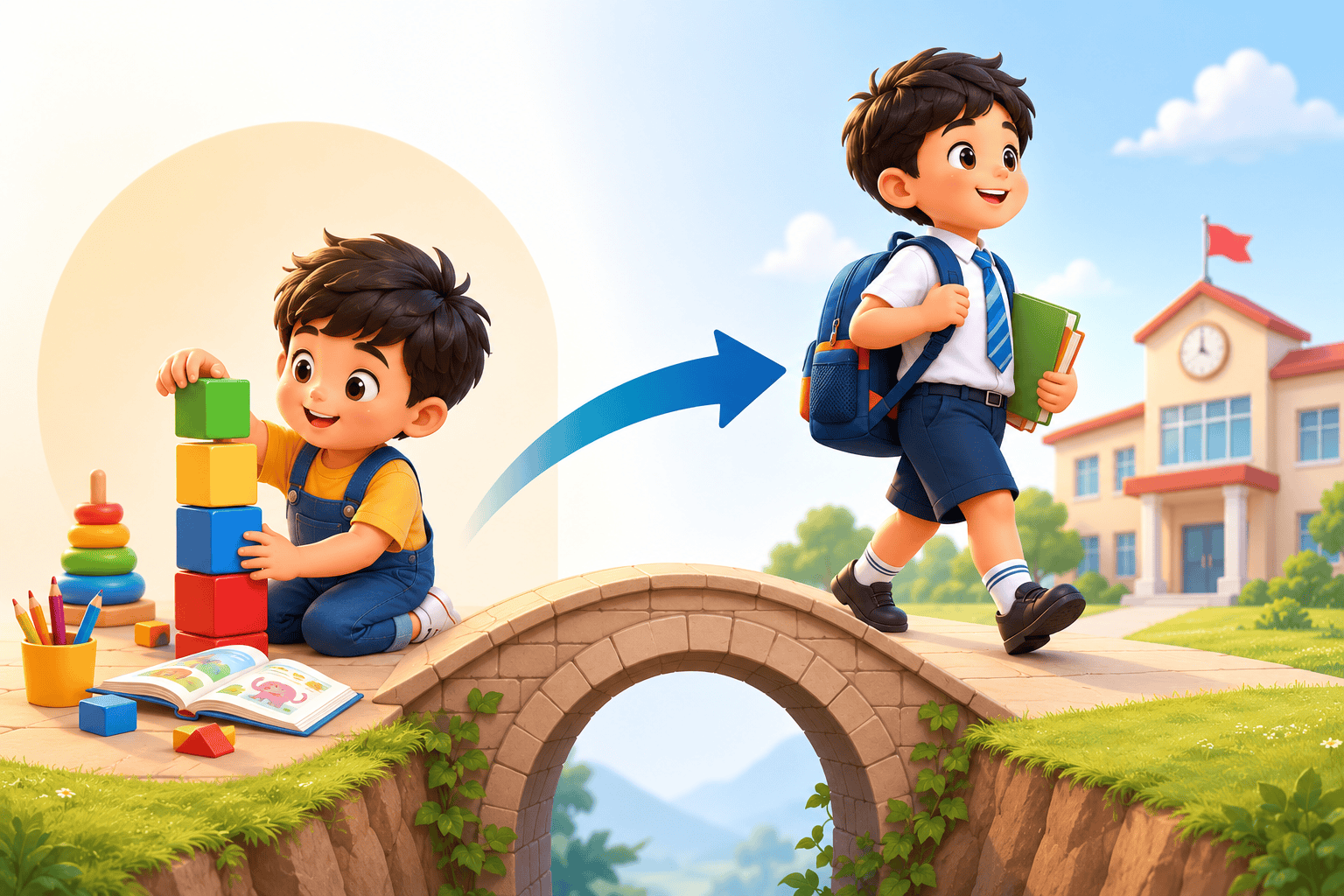
“The strongest buildings are built on strong foundations. A child’s education is no different.”
Many parents believe that real education begins only in Class I. They often think that Nursery, LKG, and UKG are simply years of playing, singing rhymes, and colouring pictures. While these activities are part of early education, they have a much bigger purpose.
The early years of a child’s life are when the brain develops most rapidly. During this time, children learn how to think, communicate, solve problems, build relationships, and understand the world around them. These skills become the foundation for everything they learn in Primary School and beyond.
Nursery Is About Preparing Children to Learn
The purpose of Nursery is not to make children memorize textbooks or complete pages of homework. Instead, it prepares them to become confident learners.
In a well-designed Nursery classroom, children learn to:
- Listen carefully to instructions.
- Express their thoughts and feelings.
- Ask questions without hesitation.
- Share and work with other children.
- Develop confidence to participate.
When these habits are formed early, children find it easier to adapt to the structured environment of Primary School.
Language Development Begins Early
One of the greatest advantages of Nursery education is language development.
Children learn new words every day through stories, songs, conversations, picture books, and classroom activities. They gradually become comfortable expressing themselves in English while continuing to strengthen their Hindi language skills.
By the time they enter Class I, they are better prepared to understand instructions, communicate with teachers, and participate in classroom discussions.
Language is not only about speaking—it is the key to learning every subject.
Learning Through Play Has a Purpose
- Many parents wonder why Nursery children spend so much time playing.
- The answer is simple: children learn best through meaningful play.
- Building blocks introduce shapes and problem-solving.
- Puzzles improve observation and logical thinking.
- Drawing develops creativity and hand control.
- Storytelling builds imagination and listening skills.
- Group games teach cooperation, patience, and teamwork.
- Every activity has a learning objective, even if children see it as fun.
Developing Good Habits Early
Primary School requires children to manage simple responsibilities every day.
Nursery helps children develop habits such as:
- Keeping their belongings organised.
- Washing hands before meals.
- Waiting patiently for their turn.
- Respecting teachers and classmates.
- Completing small tasks independently.
These everyday habits make the transition to Primary School much smoother.
Building Confidence Before Academics
A confident child is more willing to participate, ask questions, and try new activities.
Nursery provides many opportunities for children to build confidence through:
- Participating in classroom discussions.
- Performing in cultural programmes.
- Art and craft activities.
- Role play and storytelling.
When children experience appreciation and encouragement from teachers, they begin to believe in themselves.
Confidence often becomes the foundation for future academic success.
Social and Emotional Development Matters
Success in school depends on much more than reading and writing.
Children also need to learn how to:
- Handle small disappointments.
- Show kindness and empathy.
These social and emotional skills help children adjust to classroom life and build positive relationships.
The Role of Parents
Parents play an equally important role in building a strong foundation.
Simple daily activities can make a big difference:
- Praise effort instead of perfection.
- Allow children to play and explore.
- Maintain regular routines for sleep and meals.
- Spend quality time without mobile phones or television.
When learning continues at home, children develop faster and enjoy school more.
How Schools and Parents Can Work Together
The best learning happens when schools and families work as partners.
Regular communication between teachers and parents helps everyone understand a child’s strengths, interests, and areas where additional support may be needed.
When children receive consistent encouragement at both home and school, they feel secure, motivated, and eager to learn.
Looking Beyond Marks
Education is not only about examination results.
A strong Nursery foundation helps children become:
- Independent problem-solvers.
These qualities support success not only in Primary School but throughout life.
A Strong Beginning Creates Endless Possibilities
Every child deserves the opportunity to begin their educational journey with confidence and joy.
The lessons learned in Nursery may appear simple, but they shape the way children think, communicate, learn, and interact with the world. They build the confidence to ask questions, the discipline to follow routines, the curiosity to explore, and the values to become kind and responsible individuals.
At Samfoun Academy, we believe that the early years are the most important years. Our caring teachers, activity-based learning, safe environment, and child-centred approach help every child build a strong foundation for future success.
Because when the foundation is strong, every new step becomes easier—and every child has the opportunity to reach their full potential.